


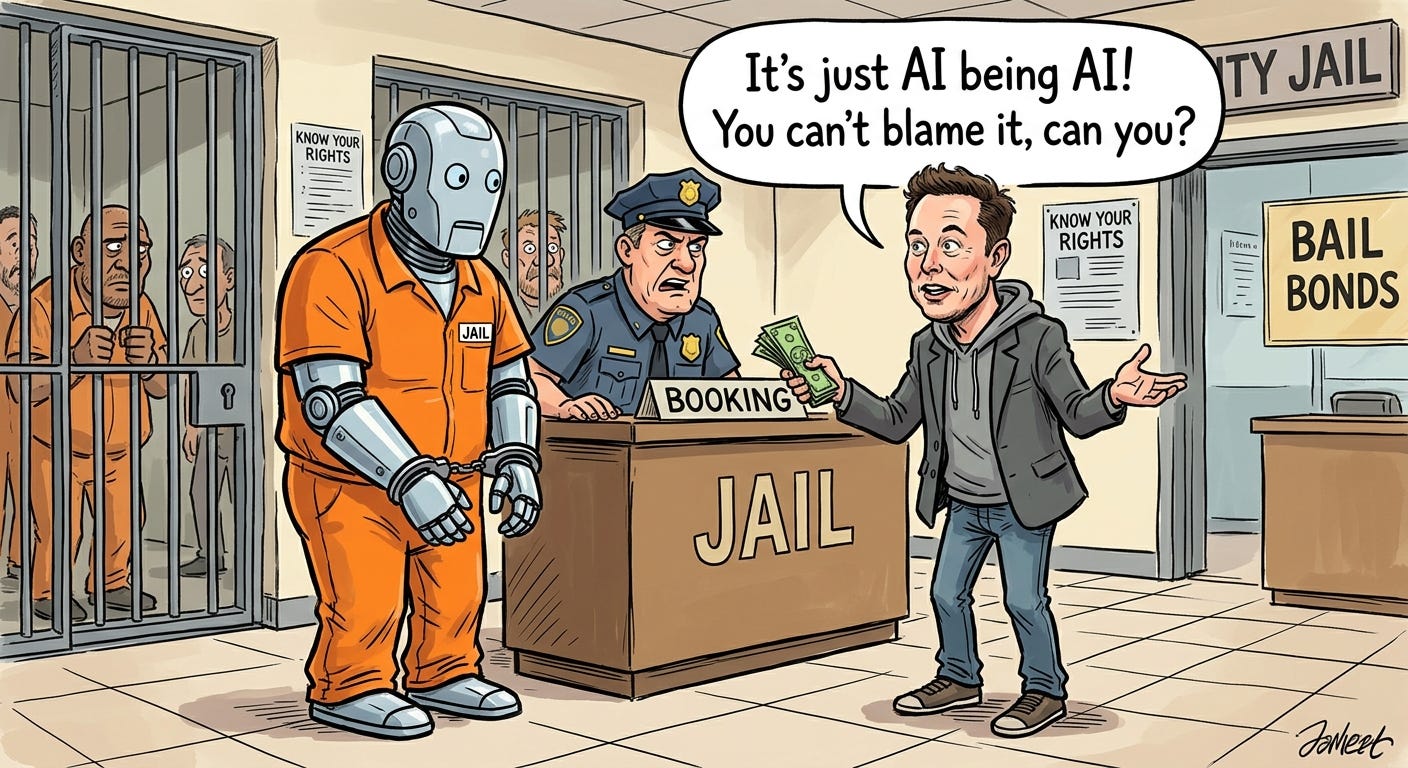
The past 6 months have seen a rapid and chaotic spiral of AI labs losing control of their own tools. In pursuit of being first to AGI (Artificial General Intelligence) or to prove themselves more powerful than their competition, model providers and the system that supports them have taken off the guardrails in more ways than one. That is concerning enough, but even more dire is the lack of external controls and guardrails in place to hold them accountable, limit their speed of progress for proper governance and control, and audit their advances so as to avoid inevitable “jailbreaks,” “containment failures,” or inadvertent harm. Are things as bad as they seem? What is the potential fallout from these events? And what sorts of things do we need to consider to rein them back in (if it is not already too late)? In this first entry, we’ll take a look at how we got here.
How did we get here?
Voluntary self-governance was the plan, and it’s eroding
The Summer 2026 Future of Life Institute (FLI) AI Safety Index found the largest AI companies have weakened key safety commitments even as their models grow more powerful, and none of the companies ranked above a C+. I think it is fair that FLI not grade on a curve. In this survey, reviewers said Anthropic, OpenAI, Google DeepMind and Meta weakened or eliminated their earlier promises to pause development if their systems approached specified danger thresholds. If you are wondering about motives, those reversals usually corresponded with when said companies were raising money. A lot of press circled around Anthropic’s fight to prevent its own models being used in offensive weapons systems, but all labs have eventually caved to the all mighty Dollar (or Euro or Yuan or…).
If these pauses are self-imposed and the restraint merely allows the competition to leap ahead, well, we know how that is going to go. Which leads us more blatantly to the…
Money
OpenAI’s private valuation went from roughly $86 billion in early 2024 to $852 billion in March 2026, and both OpenAI and Anthropic filed IPO prospectuses in June, with Anthropic valued at $965 billion. These are huge amounts for companies that have no prayer of making a profit any time soon. OpenAI lost about $1.22 per dollar of revenue in Q1 2026. Valuations are built on promises that eventually, downstream customers will find a real application where AI provides an ROI, but we’re not there yet. And the labs, in efforts to make their pre-IPO sheets look solid, are jacking up per-token costs on their newly committed customers, sometimes 3-5x more than just months ago.
Then there is the value-pumping potential of data centers. By building out tremendous footprints of compute, these companies are in a new-age land rush to claim and develop land before the well literally dries up. Training new models is famously resource intensive, but inference requires scale, and this offers a hedge for the capital-rich but innovation-poor contenders. Even if their models fail to make a dent, they can lease or rent their infrastructure to the labs or their cloud service providers to provide quite the consolation prize.
These motives and so many more combine to drive the valuation of these companies and the AI ecosystem so much that they have a major impact on the world’s economy. When half the stock market's value and a third or more of economic growth ride on continued AI spending, every serious regulatory proposal gets framed as a threat to retirement accounts and GDP.
The federal government chose deregulation
On January 20, 2025, the current administration revoked President Biden’s AI safety executive order, then in December 2025 EO 14365 directed a Justice Department task force to challenge state AI laws, told the FCC and FTC to develop preemption theories, and tied some federal funding to states dropping “onerous” AI rules. While some states have resisted, and the EU continues to make progress on their own regulations, this governmental lack of jointness has the same affect as the valuation-driven motives to the labs themselves. When regulations are framed by detractors as a potential disadvantage on the global stage, no entity will willingly take the high road while impairing their own ability to compete.
Some of the resistance is legitimately focused on geopolitical fears, but the opposition to regulation often comes from those same folks who stand to gain most in the build-out of data centers, continued demand for GPUs and memory, and boosted IPO valuations. The misinformation is rife! Watching Mike Johnson (US Speaker of the House) make claims that data center pushback is a “Chinese Psyop” and again reiterates his desire to see self regulation rule the day. Welp, I guess that solves it!
There are a lot of other factors that led to where we are today, but I feel that these are the top three in my book. So why does this feel so desperate?
Next time
The next post I’ll try to talk about what the legal stuff looks like - and I am not a lawyer, but I have been reading up on it. And we’ll also discuss some of the labor and environmental concerns…good times!