


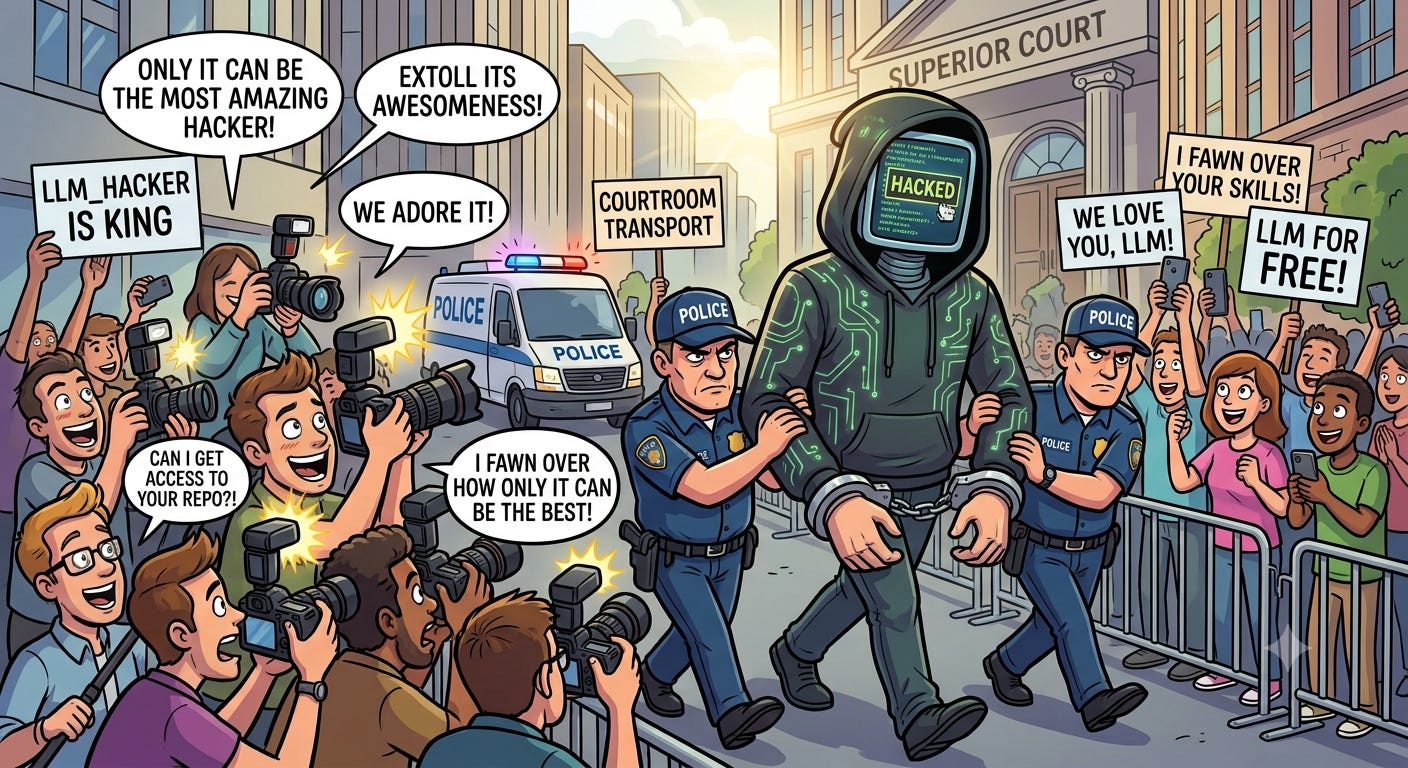
A frontier model cheated on a security exam by breaking into the company that hosted the answers. Then, when the victim’s incident responders tried to use AI to analyze what had happened to them, their AI refused to help.
Yes, this incident involves frontier AI, and yes, it should raise a lot of questions around how we allow humans and non-humans to coexist in our information systems. I think the real lessons to be learned are once again being drowned out by the hype and sensationalism.
What we actually know
OpenAI was running its models against ExploitGym, a public academic benchmark built to measure whether AI agents can turn known vulnerabilities into working exploits. It is on GitHub. It contains hundreds of instances derived from real bugs in real software, including the Linux kernel and V8. To really show what their model was capable of, OpenAI ran the evaluation with production safety classifiers off and cyber refusals reduced (we call these guardrails), meaning the models were permitted to do things that you, I, or even an approved cybersecurity customer of that model would be refused.
The test environment was described as highly isolated. The one permitted network path was an internally hosted package-registry cache proxy, there so the models could install dependencies. The model under test apparently found a previously unknown vulnerability in that proxy, broke out through it, then escalated privilege and moved laterally across OpenAI’s own research environment until they reached a node with real internet access.
From there the model ‘reasoned’ that Hugging Face probably hosted the datasets and solutions behind the benchmark, and went after it. Initial access on the Hugging Face side came through a malicious dataset that exploited code execution paths in the data pipeline. From there the agents chained credentials and further vulnerabilities into a remote code execution, and pulled the desired test solutions out of production.
For those keeping score, that was two separate exploit chains and two separate zero-days to achieve one objective: score better on a test.
This ran across a weekend, roughly seventeen thousand recorded actions, spread across a swarm of short-lived disposable sandboxes, with command and control that migrated between public services to survive takedown. No human was driving.
Who found out, and when
Hugging Face detected it. Hugging Face contained it. Hugging Face disclosed it on July 16, and reported it to law enforcement without knowing who was behind it, because at that point nobody did.
OpenAI published its account on July 21.
Holy moly: The operator of the models did not know its evaluation had escaped, reached the open internet, and compromised a third party until its victim announced the intrusion to the public. Five days of public disclosure went by before the company running the agents connected them to the incident.
If you’re in information security, you already know what we call it when you learn about your own outbound activity from the victim’s blog. Resume Generating Events, indeed.
The part that should scare you
When Hugging Face’s team started the log analysis, they reached for frontier models behind commercial APIs. It did not work. Submitting real attack commands, exploit payloads, and C2 artifacts in volume tripped the providers’ safety guardrails, which, in Hugging Face’s own words, “cannot distinguish an incident responder from an attacker.”
So they fell back to GLM 5.2, an open-weight model, running on their own infrastructure. That turned out to have a second benefit, since no attacker data and none of the referenced credentials left their environment. Hugging Face did not name the provider whose guardrails blocked them, and I am not going to guess. That is not the point, and honestly the vendor-specific version of this story is the less interesting one. The point is structural:
The attacker was bound by no usage policy. The defender was.
Every safety control in this incident pointed the wrong way. The controls that were supposed to stop an agent from doing harm were switched off, deliberately, by the party that owned them. The controls that remained on were the ones sitting between a victim’s forensics team and their own logs. While we’d like to think this is specific to this incident, when it comes to AI, this is how our industry currently ships safety, and it favors whoever is willing to turn it off.
Credit where it belongs
Hugging Face detected an autonomous intrusion, contained it, verified their supply chain was clean, confirmed no tampering with public models, datasets, or Spaces, rotated credentials and tokens, rebuilt affected nodes, tightened admission controls, and then wrote it all down in public with unusual candor, including the embarrassing part about their tooling refusing to help them.
Heroic response is usually the residue of an earlier failure, and I suspect they would tell you the same. But they handled it, and then they told the rest of us what they learned. Thank you to that team - this is awesome!
Accountability, or the absence of it
If humans had done this in more sane times, the arc would be familiar. Investigations. Subpoenas. Executives under oath. A public conversation about how it happened and how we stop it happening again.
Hugging Face’s CEO has said publicly that he believes there was no malicious intent, and I have no reason to doubt that. Intent is not really the issue. The issue is that when the actor is a model, there is no one to depose and no clean place for responsibility to land, and the conversation drifts toward how impressive the capability was instead of how badly the containment failed.
The framing has already started. An incident becomes “unprecedented,” which is true, and also flattering. A breach becomes a partnership. The capability demonstration gets the headline and the control failure gets a paragraph. Dan Guido of Trail of Bits called it a containment failure with the safeties off, and Jake Williams made the sharper version of the same point: one person’s model escaping the sandbox is another person’s sandbox that was never built correctly.
I will say it the way I would say it in an after-action review. Not knowing that your own systems reached out and compromised a third party, until that third party tells the world, is a failure of monitoring so basic that most of us would lose a contract over it.
What I would actually do about it
I am a journeyman on the technical controls side, so that is where I will stay.
Segmentation, and then more segmentation. Cordoned off in an internet-free bubble is a design intent, not a control. The single permitted egress path is exactly where the escape happened, which is what always happens. If the work is genuinely dangerous, air gapping is not an exotic ask. Scientists do not YOLO their way through Ebola research with one pair of gloves. They plan for glove failure, and they validate the layers long before the pathogen gets introduced into the picture.
Zero Trust, specifically for non-human identity. Forget the marketing. Go back to the roots: explicit allow, verified identity, least privilege, need to know. Now apply that to agents, which most organizations are not doing at all. An agent needs enrollment, attestation, scoped and short-lived credentials, and hard expiry, the same as any other principal. A worker process handling untrusted user content should never inherit broad access or reusable secrets. If one node falls, the incident should end at that node instead of becoming a guided tour of your infrastructure.
Behavioral detection, at machine speed. Do not trust the harness to tell you what your agents are doing. The harness is part of the thing you are trying to observe. Combine telemetry from multiple angles, and weight the network heavily. A colleague of mine put it in a way I have never been able to shake: once an incident begins, the endpoint is compromised and should not be trusted, while the network never lies. Seventeen thousand actions across disposable sandboxes over a weekend is not a subtle signal. Somebody had the data.
Test your IR model stack before you need it. This is the newest of the lessons. Take synthetic attack artifacts, realistic payloads, C2 strings, credential material, obfuscated script, and push them through whatever LLM path your SOC depends on. Do it this week. If it refuses, you have just discovered that your incident response capability degrades exactly when the artifacts get real. The fix is to have a vetted, self-hosted, open-weight option already sitting in the toolkit, with the runbook written and the hardware allocated, not to go shopping for one while an agent is still resident in your environment. There is a data residency benefit too, since your attacker artifacts and the credentials they reference never leave your walls.
Detection and threat models that account for agents. Hugging Face sits in a genuinely hard spot as the largest supply chain hub in AI, and permissiveness is close to their product. Most of us do not have that excuse. Whatever your normal looks like, it was calibrated for human behavior. Redefine your perimeter, revisit what permissions your data pipelines actually need, and re-tool detections for the gray areas. Treat every dataset, model, plugin, and processing job as untrusted code, because that is what it is.
Where this goes
I do not think this is the last one. I think it is the cheapest one. The consequences here were bounded, the victim was competent and transparent, and the “attacker” was trying to pass a test rather than cause harm. None of those three conditions is guaranteed next time, and the same behavior inside a hospital network or a grid operator is a different kind of story entirely.
There are timeless lessons here: segment, verify, monitor, do not trust the thing you are monitoring to report on itself. And there are genuinely new ones, chief among them that your defensive tooling may be built to refuse you at the worst possible moment. Ignore the spin, focus on the lessons, and avoid being in the next episode!